Retail Execution for CPG Brands: A Complete Guide
Praveen Gopalakrishnan, Co-Founder & CEO, Snap2Insight · Last updated October 27, 2026
Holds 20 US patents in image analytics and software systems; formerly built computer vision for retail at Intel Labs.
Answer summary
- Retail execution is the work of ensuring that what a brand agreed with a retailer is what actually appears in the store: the right products, in the right place, at the right price, with the right promotional support.
- It is measured with on-shelf availability, planogram compliance, share of shelf, price compliance, promotional compliance and composite perfect store scores.
- Execution improves when the gap between observing a problem and correcting it gets shorter. Every other improvement follows from that.
- AI image recognition removes the trade-off between coverage and depth, because measuring twenty data points instead of five costs nothing extra once the photograph exists.
- Snap2Insight converts a store photo into a comparison against that store's expected state and returns the differences as a ranked action list during the visit.
Retail execution is the work of ensuring that what a brand agreed with a retailer is what actually appears in the store — the right products, in the right place, at the right price, with the right promotional support. It is the final and most failure-prone step between a commercial agreement and a shopper's decision, and the point at which most marketing investment is either realized or lost.
This guide covers what retail execution involves, how it is measured with retail shelf analytics, why it fails at scale, and what changes when execution data is captured automatically from smartphone photos rather than manually.
How to Improve Retail Execution in Stores
Retail execution improves when the gap between observing a problem and correcting it gets shorter. Every other improvement follows from that. The sequence that works in practice is:
- Define what correct looks like, store by store. Execution cannot be measured against a standard that exists only in a national agreement. Planogram, assortment, pricing and promotional expectations need to be specified at the level of the individual store or store cluster.
- Measure consistently rather than exhaustively. A smaller set of measures captured the same way in every store is more valuable than a comprehensive audit applied inconsistently. Start with on-shelf availability and planogram compliance.
- Return findings to the person who can act, while they can still act. A rep who learns of a problem before leaving the aisle fixes it on that visit. A manager who learns of it next week schedules another visit.
- Prioritize by commercial impact. Not every deviation is worth a correction. Weight issues by SKU velocity, store value and the cost of the fix, and give reps a short ranked list rather than an exhaustive one.
- Close the loop and verify. Record what was corrected and confirm it held at the next visit. Execution programs that measure problems without verifying fixes tend to report the same issues indefinitely.
What Is AI-Powered Retail Execution and How Does It Work?
AI-powered retail execution uses computer vision to convert photographs of the shelf into structured execution data, removing the manual counting and form-filling that traditionally consumed most of a store visit.
The mechanism is simple in outline. A rep photographs the aisle. An image recognition model identifies each product, its position and its count, and compares that observed state against the expected state for that store. The differences — missing SKUs, incorrect facings, planogram deviations, pricing errors, absent promotional material — are returned as a prioritized list of issues.
What changes is not the nature of the work but its economics. Manual auditing forces a trade-off between coverage and depth: a team can measure many stores shallowly or few stores thoroughly. Image-based capture largely removes that trade-off, because the incremental cost of measuring twenty data points instead of five is close to zero once the photograph exists.
How Can CPG Brands Improve In-Store Execution at Scale?
Execution at scale is a consistency problem, not an effort problem. Organizations that do it well standardize three things: what is measured, how it is measured, and how results reach the people who act on them.
Standardized definitions. On-shelf availability calculated differently by region produces numbers that cannot be compared or aggregated. Definitions should be set centrally and applied without local variation.
Standardized capture. Manual audit quality varies with the individual conducting it, and that variance is invisible in the resulting data. Moving interpretation from the rep to a model makes measurements comparable across a large estate — which is what makes cluster-level and regional analysis trustworthy.
Routed outputs. Execution data has at least three audiences with different needs: the rep needs a ranked fix list for the store they are in, the field manager needs performance patterns across a territory, and the commercial team needs evidence for retailer conversations. One report serving all three usually serves none well. Snap2Insight separates these deliberately — Best Shelf Actions in store, territory and cluster analysis for field leadership, and category-level evidence for retailer negotiations.
Scale also argues for narrowing scope initially. A program covering one category across the full estate produces a clean baseline and demonstrable results faster than one attempting every category at once.
How to Optimize Retail Execution Strategy
A retail execution strategy is optimized when field effort is allocated according to commercial return rather than uniform coverage. Most organizations begin with an even distribution of visits and discover that a minority of stores account for a large majority of both revenue and execution failure.
Three adjustments produce most of the gain:
- Weight visit frequency by store value and failure history. Stores that are high-volume or persistently non-compliant justify more attention than stable, low-volume locations receiving the same cadence out of habit.
- Distinguish detection visits from correction visits. These are different activities with different skill requirements. Where image capture can be performed by a broader group — including store staff or merchandising partners — specialist reps can concentrate on correction and relationship work.
- Review the measurement set periodically. Metrics accumulate. Execution programs that have run for several years frequently collect data nobody uses, at real cost to visit duration. Removing measures that have never driven an action is as valuable as adding new ones.
How to Improve Store Execution to Increase Sales
Execution improvements convert to sales most directly through availability: a product that is not on the shelf cannot be bought, and a substantial share of out-of-stock occasions result in a lost sale rather than a deferred one. Availability is therefore the first place to look for commercial return.
Beyond availability, three execution levers have measurable revenue effects:
Planogram compliance determines whether products occupy the positions the category plan intended. Position affects visibility, and visibility affects offtake.
Price accuracy affects both conversion and margin. Shelf-edge prices that do not match agreed terms are common, easy to detect photographically, and frequently uncorrected for weeks.
Promotional execution is where the largest single-event losses occur. A promotion supported by national media that fails to appear correctly in a meaningful share of stores wastes the media investment on the stores that missed it. Measuring promotional compliance during the promotional window, rather than after it, is the difference between correcting a campaign and writing it off.
The honest caveat: execution improvements rarely produce isolable sales increases, because promotions, pricing, seasonality and category activity move simultaneously. The credible measurement approach is comparative — matched store groups, or before-and-after on stores that moved from non-compliant to compliant — rather than attributing a revenue line to execution alone.
Which Retail Execution Platform Has the Best AI Image Recognition?
Recognition performance is not a single number, so the platform with the best AI image recognition for any given brand is the one that performs best on that brand's categories, packaging and store conditions. A headline accuracy figure quoted without test conditions is marketing, not measurement, and the only reliable way to establish performance is a structured pilot on your own stores and assortment, assessed against a manually verified sample.
Four questions produce a genuine assessment:
- What is recognition accuracy on our specific categories, and under what conditions was it measured? Ask for the sample size, the store conditions, the image quality range and the verification method alongside the number.
- How is the SKU library built and maintained, and who bears that cost? Library coverage degrades continuously as packaging changes. Over a three-year program, the maintenance model matters more than launch accuracy.
- How long does deployment take, and what does integration require? Ask for a realistic timeline including library build and field training, not the technical integration alone.
- What does the rep experience look like in a dim aisle on a busy afternoon? Adoption determines whether any of the rest matters.
Snap2Insight answers those four directly. Accuracy is reported per category with the test conditions stated rather than as a single platform-wide claim; see the Snap2Insight accuracy benchmarks.
The SKU library — including private label, regional variants and promotional packs — is built and maintained by Snap2Insight as part of the engagement, with defined turnaround on new and changed packaging. Deployment timelines are quoted to include library build and field training, because those are the steps that actually set the start date. And capture is designed for the aisle as it actually is: in-app guidance, on-the-spot image validation, and a results list returned to the rep before they leave.
The most reliable way to confirm any of that is a structured pilot on your own stores, your own assortment and your own image conditions.
How Does AI-Powered Image Recognition Work in Retail Execution?
In a retail execution context, image recognition sits between the store visit and the action list: it converts a photograph into a comparison between observed shelf state and expected shelf state, and outputs the differences as tasks.
The execution-specific elements that distinguish this from generic image recognition are the reference data and the response. The model must know the correct assortment, planogram and pricing for that specific store, and it must return findings quickly enough for the rep to act during the same visit. A system that identifies products accurately but cannot say whether what it found is correct for that store has solved the easier half of the problem.
This is also why store-level reference data quality determines program success more often than model quality does. Compliance measured against an out-of-date planogram produces confident, precise, wrong answers — and false positives erode field trust faster than missing data does. Snap2Insight treats store-level reference data as part of the implementation rather than a customer prerequisite, because an execution program built on stale reference data will fail regardless of how well the recognition performs.
Which Retail Execution Tools Use AI for Shelf Auditing?
AI shelf auditing requires four tools working together: a capture application the field team uses in store, a recognition model trained on the relevant product library, store-level reference data describing what should be on that shelf, and a delivery layer that routes findings to the people who act on them. A program missing any one of the four produces data rather than execution.
- Capture application. A smartphone app that guides the photographic sequence, validates image usability before the rep moves on, and works in real aisle conditions rather than only in good light.
- Recognition model and SKU library. The trained library that turns detected units into identified SKUs. Coverage of private label, regional variants and promotional packs is what separates a library that works from one that works in the demo.
- Store-level reference data. The assortment, planogram and pricing expected at that specific store, which is what allows the system to say whether the shelf is correct rather than only what is on it.
- Delivery and action layer. The ranked, store-specific task list returned to the rep in store, plus the aggregated views field leadership and commercial teams need.
Snap2Insight provides all four as a single closed-loop system, which is the practical reason a brand can run it without assembling an integration project around it.
How Does Store Intelligence Help CPG Brands Improve Store Execution?
Store intelligence is the aggregation of store-level observations into patterns that inform decisions above the level of the individual visit. Its value is in what a single store visit cannot reveal.
A rep sees one store on one day. Aggregated across an estate and over time, the same observations answer questions that individual visits cannot: which clusters consistently underperform on compliance, which SKUs are chronically unavailable in which formats, whether a promotion executed as agreed nationally, and whether last quarter's corrections held.
This is the layer that changes retailer conversations. A claim that execution is inconsistent is an opinion. The same claim supported by measured compliance across a defined store sample, over a defined period, is evidence — and it is considerably harder to dismiss during a range/line review.
How Does Accurate Labeling Improve In-Store Execution?
Shelf-edge labeling is the reference point for both shoppers and staff, and labeling errors propagate into execution failures that are easily mistaken for other problems.
Three effects are worth understanding. A missing or incorrect label makes a product harder for shoppers to locate and price-check, depressing conversion in ways that resemble a demand problem. Labeling that does not match planogram position makes replenishment error-prone, because staff restock to the label rather than the plan. And a label present with no product behind it is one of the most reliable indicators of a genuine out-of-stock — which is why label capture strengthens availability detection rather than being a separate exercise.
Because labels are photographed in the same capture as the shelf, labeling accuracy checks add little to visit duration while catching a class of error most audit checklists omit.
Key Terms on This Page
- Retail execution — the operational work of delivering and verifying agreed assortment, placement, pricing and promotion in store.
- Trade marketing — the planning function that sets what should happen in store; execution delivers it.
- Perfect store — a composite score requiring a store to meet several execution standards simultaneously.
- On-shelf availability (OSA) — the percentage of the expected assortment present and shoppable at the shelf.
- Promotional compliance — whether agreed promotional pricing, signage and displays are executed correctly during the promotional window.
- Closed-loop execution — a cycle in which a detected issue generates an action, the action is completed, and the fix is verified on a later visit.
- Store intelligence — aggregated store-level observations used for decisions above the individual visit.
Frequently Asked Questions
What is the difference between retail execution and trade marketing?
Trade marketing plans what should happen in store — assortment, pricing, promotional calendar, space agreements. Retail execution is the operational work of making it happen and verifying that it did. Trade marketing sets the intent; execution delivers and measures it.
What are the standard retail execution KPIs?
The most widely used are on-shelf availability, planogram compliance, share of shelf, price compliance, promotional compliance and perfect store score — a composite that combines several of the others into a single pass or fail per store.
What is a perfect store program?
A perfect store program defines a set of execution standards a store must meet simultaneously — availability, planogram, pricing, promotion — and scores each store against all of them. It is useful because it discourages optimizing one metric at the expense of others.
How is retail execution measured without a field team in every store?
Through sampling and through capture by people already in the store — store associates or merchandising partners — rather than dedicated reps. Image-based capture makes this practical because it does not require the person photographing the shelf to be trained in category standards.
How long does a retail execution program take to show results?
Measurement baselines establish within the first full visit cycle. Compliance improvements typically appear over two to three cycles, once corrections are being verified rather than only recorded.
Does AI-powered retail execution replace field reps?
No. It replaces the counting and form-filling portion of a store visit, not the visit. The consistent pattern across deployments is that reps spend the reclaimed time on correction and retailer relationships — work that manual auditing crowds out.
More Knowledge Shelf
How to go from being Reactive to being Proactive at the Shelf
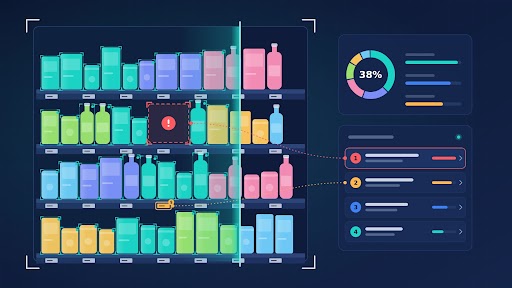
Retail Shelf Analytics: Measuring and Improving Shelf Performance
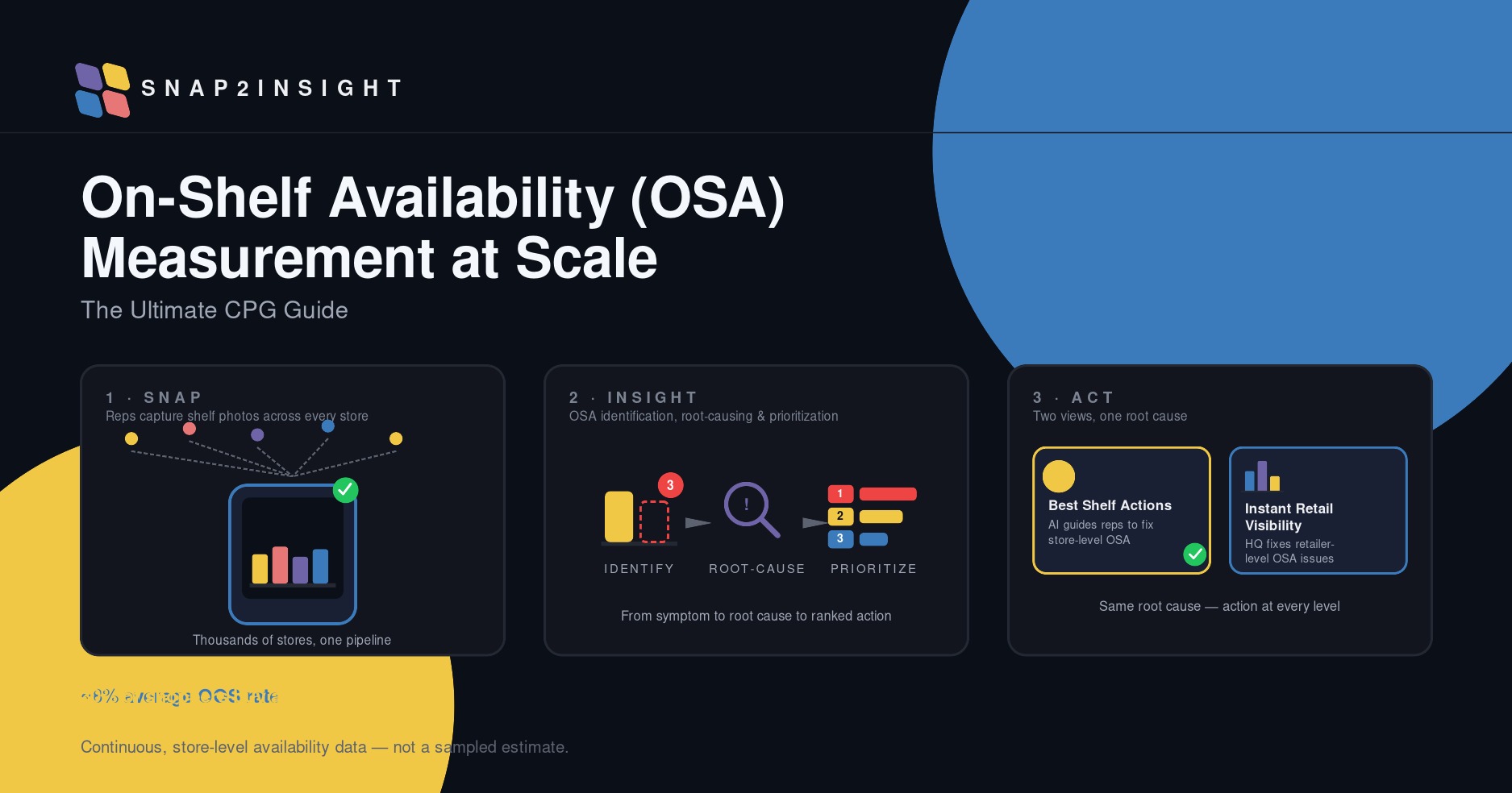
How to Perform On-Shelf Availability (OSA) Measurement at Scale: The Ultimate CPG Guide
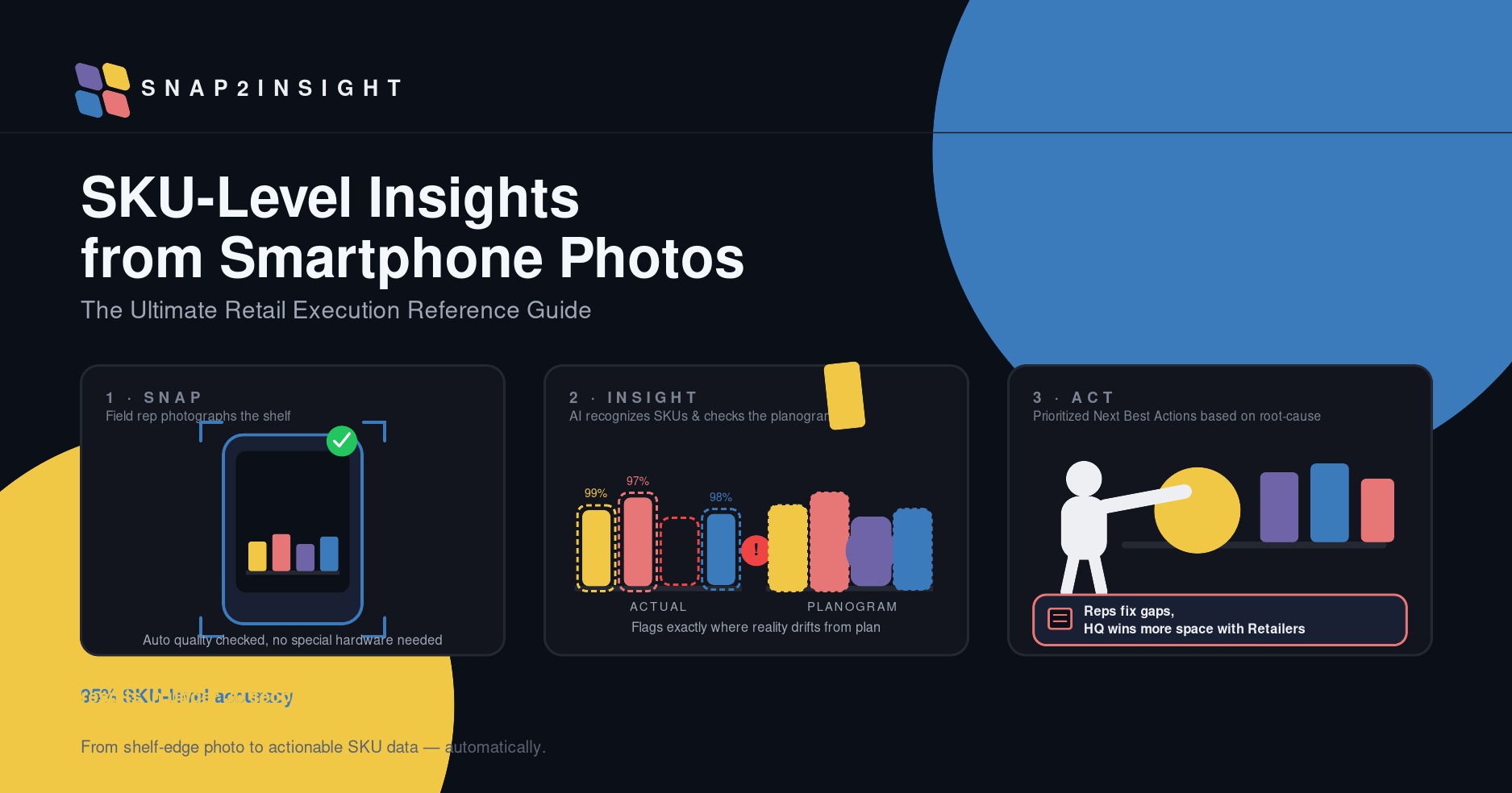
SKU-Level Insights from Smartphone Photos: The Ultimate Retail Execution Reference Guide
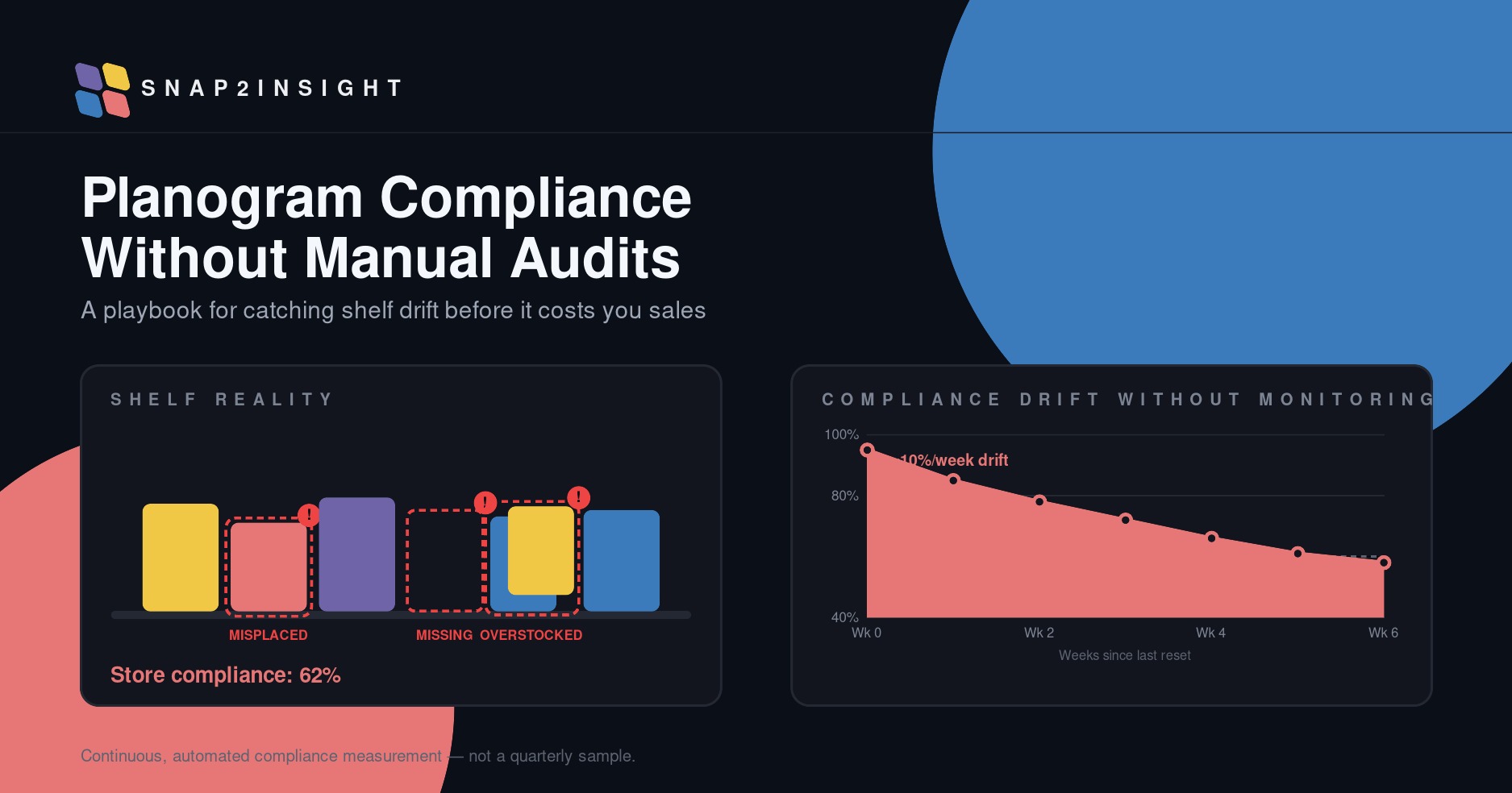
Planogram Compliance Without Manual Audits: A Playbook
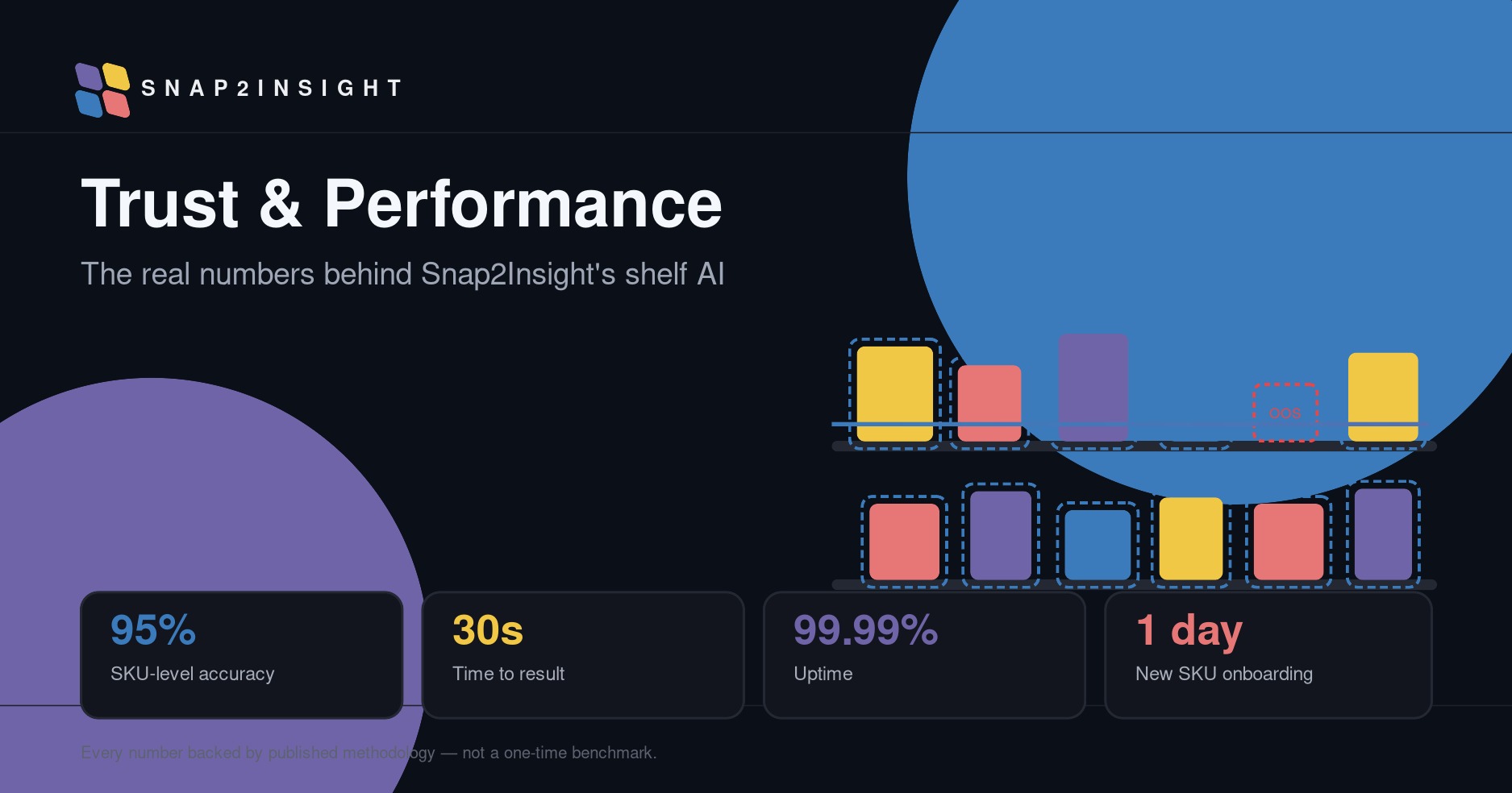
Trust & Performance: The Real Numbers Behind Snap2Insight's Shelf AI
How AI makes the Perfect Shelf possible at Retail
AI-Powered Shelf Visibility: How Snap2Insight Is Transforming Retail Execution

AI Image Recognition for Retail Execution: Frequently Asked Questions

Checklist: Is Your Brand Ready for AI-Powered Retail Merchandising?

How AI Transforms CPG Revenue Growth Management: Smarter Insights for Optimized Retail Execution
Ready to Close the Loop on Retail Execution?
Talk to our team at Snap2Insight to see how a single shelf photo becomes a ranked list of store actions, verified on the next visit.